 StudyMina
IELTS Academic vs General Training
IELTS Academic and General Training share Listening and Speaking but differ in Reading and Writing. See what changes, who needs which, and how to choose.
In this article
If you are registering for IELTS, one of the first choices you must make is Academic or General Training. The wrong choice can mean paying for a test your university or immigration authority will not accept. The good news is that the two versions are closer than most people think: they share half of the test. This guide explains exactly what is the same, what differs, and how to decide.
The short answer
- IELTS Academic is for people applying to study at undergraduate or postgraduate level, or for some professional registrations.
- IELTS General Training is for people going to English-speaking countries for secondary education, work experience or training programmes, and it is commonly used for migration.
- Never guess. The organisation that asked you for IELTS decides which version you need, so ask them or check their website before you book.
What is the same
Both versions test four skills and report results on the same 9-band scale. Every candidate, whichever version they take, sits the same Listening test and the same Speaking test. Only Reading and Writing differ.
| Component | Format (both versions) |
|---|---|
| Listening | About 30 minutes, 40 questions, recordings played once |
| Speaking | 11 to 14 minutes, a face-to-face conversation with an examiner |
| Total test time | About 2 hours 45 minutes |
For Listening and Reading, your raw score out of 40 is converted to a band. For Writing and Speaking, trained examiners assess your performance against published criteria. Each of the four component scores is reported separately, and your overall band is the average, reported in whole or half bands.
What differs
| Component | Academic | General Training |
|---|---|---|
| Reading (60 minutes, 40 questions, three sections) | Three long texts, from descriptive and factual to discursive and analytical, taken from sources such as books, journals and newspapers | Shorter, practical everyday texts such as notices, adverts and workplace documents, plus a longer general-interest text |
| Writing (60 minutes, two tasks) | Task 1: describe visual information such as a graph, chart, table, map or process. Task 2: an essay in response to a point of view or problem | Task 1: write a letter, for example making a request or explaining a situation. Task 2: an essay on a general-interest topic |
Two further points matter:
- Task 2 counts for more. In Writing, Task 2 contributes twice as much as Task 1 to your Writing score, so do not neglect it.
- Reading is scored differently. The raw-score-to-band conversion tables are not the same for the two versions, so the same number of correct answers does not give the same band on both. Do not compare scores across versions without checking the conversion.
Which one should you take?
Use this order of checks:
- Ask the organisation. Universities, professional bodies and immigration authorities publish which version they accept. Many universities require Academic; many migration programmes require General Training.
- Check the required band. Institutions often set a minimum overall band and sometimes a minimum in each skill.
- Check the validity period of results and whether they accept the delivery format you are considering.
- Only then consider difficulty. Choosing a version because it seems easier is a mistake if it will not be accepted.
Is one version easier?
That is a common question and there is no honest simple answer. The two versions test the same proficiency scale, but the content differs. Some candidates find everyday texts and letter-writing more familiar; others find academic texts and graph description more predictable once practised. What matters is that your preparation matches the version you take.
How to prepare for each version
For Academic:
- Read long, dense texts regularly, such as articles and research summaries, and practise skimming for main ideas.
- Practise describing charts and processes accurately in a formal tone.
- Practise argument essays with a clear position and examples.
For General Training:
- Practise reading short, varied everyday texts quickly and accurately.
- Practise letters in the right tone: formal, semi-formal or informal as the task requires.
- Practise general-interest essays with clear structure.
For both:
- Take timed practice tests to build pacing.
- Review mistakes and keep an error log. See our guide to preparing for exams using practice quizzes.
- Use active recall for vocabulary and structures instead of just rereading.
- Practise speaking aloud, ideally with feedback from someone who can assess it.
Use official practice materials from the test owners wherever possible. Practice questions produced by other tools, including AI tools, are not official IELTS material and can differ from the real test.
Delivery format
IELTS can be offered on paper or on computer depending on the country and test centre, and arrangements change over time. Check with an official test centre what formats are currently available where you live before you book.
Checklist before booking
- Confirm which version your institution requires
- Confirm the minimum overall band and any per-skill minimums
- Check dates, fees and delivery format with an official test centre
- Plan your preparation around the version you are taking
- Book enough time between your test and your application deadline
The best way to prepare for IELTS: StudyMina
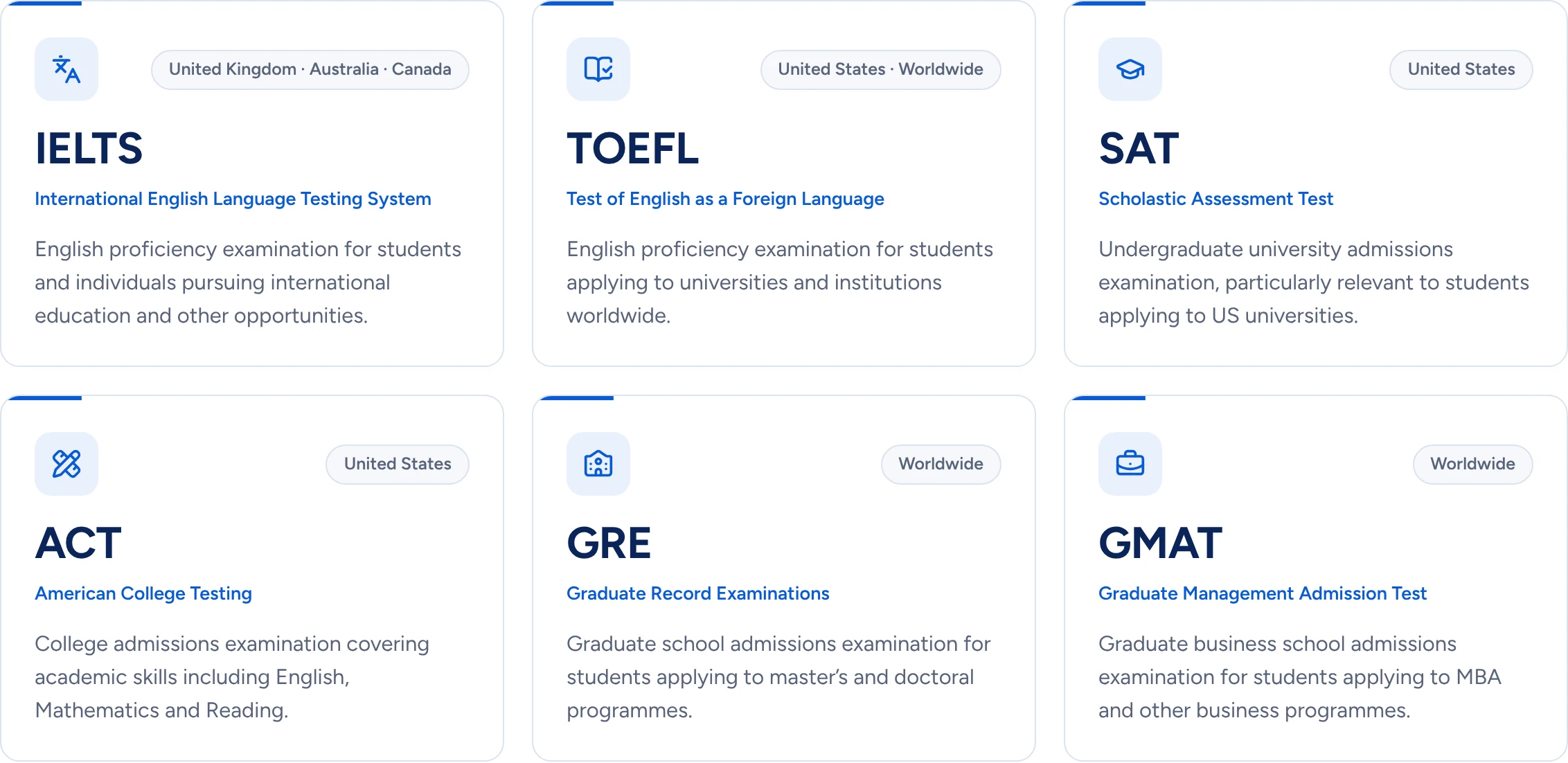
StudyMina supports preparation for IELTS, TOEFL, SAT, ACT, GRE and GMAT. Plan your weeks around your test date, ask Mina to explain grammar and essay structure, and drill vocabulary with flashcards and quizzes. Use official practice materials alongside it. StudyMina is independent and its practice is not official IELTS material.
Sources
IELTS rules, fees and formats change. Confirm the details at the official sources before you register.
- IELTS official website: ielts.org
- British Council, IELTS guide for teachers (test format and overview): takeielts.britishcouncil.org
- British Council IELTS test format page: britishcouncil.org.tr
StudyMina is independent and is not affiliated with or endorsed by the owners of IELTS.