 StudyMina
How to Take Effective Lecture Notes
Practical lecture note-taking methods, including the Cornell system, how to handle fast lecturers and slides, and how to turn notes into revision within 24 hours.
In this article
- What notes are for
- Before the lecture
- Method 1: The Cornell system
- Method 2: Outline notes
- Method 3: Mind maps
- Method 4: Question-based notes
- Handling common problems
- Paper or laptop?
- After the lecture: the 24-hour review
- A note on summarising and highlighting
- A quick checklist
- The best way to turn lecture notes into revision: StudyMina
- Sources
Good lecture notes do two jobs: they help you pay attention while you are in the room, and they give you something useful to revise from later. Most students manage neither. They either copy slides word for word, or write so little that the notes mean nothing a week later. This guide covers methods that work, how to cope with fast lecturers and slide-heavy courses, and what to do with your notes afterwards.
What notes are for
Notes are not a transcript. You cannot write everything, and trying to makes you a stenographer instead of a learner. The aim is to capture:
- Main ideas and how they connect.
- Definitions, formulas, examples and lists that you must know.
- What the lecturer emphasises, such as "this will come up again" or repeated points.
- Your own questions about what you do not understand.
Taking notes works best when you are thinking while you write, deciding what matters and rephrasing it in your own words.
Before the lecture
- Skim the topic. Even two minutes with the previous notes or the reading gives you a framework to hang new information on.
- Bring what you need and organise one place per course so notes do not scatter.
- Leave space in your notes, on paper or digitally, so you can add details later.
Method 1: The Cornell system
The Cornell method, developed by Walter Pauk at Cornell University, divides a page into three areas:
- a wide notes column on the right, for what you capture during the lecture,
- a narrow cue column on the left, where you later write questions or keywords,
- a summary box at the bottom, where you write a short summary in your own words.
How to use it:
- During the lecture, write notes in the right column.
- Afterwards, write questions or keywords in the left column that each section of notes answers.
- Cover the notes column and use the cues to test yourself.
- Write a short summary at the bottom of the page.
Its strength is that the structure builds in recall practice. The cue column turns your notes into a set of questions, which fits the evidence on practice testing we describe in our guide to active recall.
Method 2: Outline notes
Use headings and indented bullet points to show the structure of the lecture: main topic, subtopics, details. It is quick and works well when the lecturer is organised. It works less well when the lecture jumps around.
Method 3: Mind maps
Place the central topic in the middle and branch out. Mind maps are good for seeing connections and for topics with many links. They are less suited to detailed, step-by-step material such as proofs or calculations.
Method 4: Question-based notes
Write the lecture as questions and answers. "What causes X?" followed by the answer. This is slower during the lecture, but it produces notes that are already in a form you can revise from.
Handling common problems
The lecturer speaks too fast. Do not try to keep up word for word. Write keywords and key phrases, use abbreviations you will understand, and leave gaps. Fill the gaps afterwards from slides, a textbook or a classmate's notes. If the lecture is recorded, listen again to the hard parts.
The slides are given out in advance. Do not copy what is already printed. Annotate the slides instead: add the lecturer's explanations, examples and emphasis. The valuable material is what is not on the slide.
The lecturer reads the handout aloud. Use the time to mark what is important, add questions and link ideas to what you already know. Reading is not the same as learning.
You lose the thread. Write a question mark and move on. Do not stop writing to puzzle over one point and miss the next three.
Maths and technical content. Write the reasoning, not only the final result. A line of explanation next to each step is more useful than a perfect-looking formula you cannot follow later.
Paper or laptop?
Both work, and the better choice depends on you. Handwriting forces you to condense and can help attention; typing is faster and easier to organise and search. Whichever you choose, the most important part is what you do afterwards. If you type, resist copying everything verbatim, and keep distractions closed.
After the lecture: the 24-hour review
Notes that are never revisited are mostly wasted. Within about a day:
- Read through your notes and fill gaps while the lecture is fresh.
- Add cues or questions for each section.
- Close the notes and write what you remember, then check.
- Highlight what you could not recall.
- Make a few flashcards or practice questions for the key points.
Turning notes into revision material is covered in our guides to using AI to summarise lecture notes and creating flashcards from lecture notes. Whatever tool you use, check what it produces against your notes.
A note on summarising and highlighting
Many students rely on highlighting and rereading their notes. In a 2013 review of ten learning techniques, Dunlosky and colleagues rated highlighting and rereading as low utility, while practice testing and spaced practice were rated high. Notes are a good raw material, but how you review them determines how much you learn.
A quick checklist
- I skimmed the topic before class.
- I wrote main ideas and examples in my own words.
- I marked what the lecturer emphasised.
- I noted my own questions.
- I reviewed and tested myself on the notes within 24 hours.
The best way to turn lecture notes into revision: StudyMina
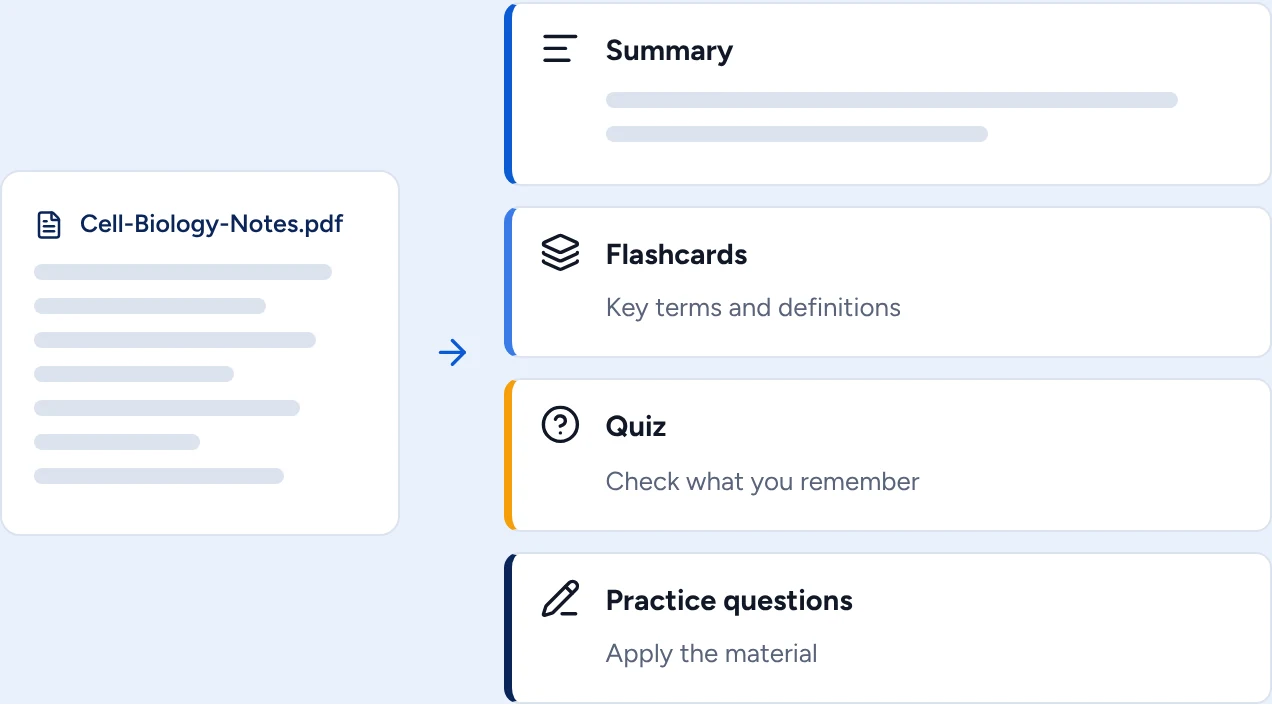
After class, upload your notes to StudyMina and it can create a summary, flashcards, a quiz and practice questions from them, so your 24-hour review starts with ready-made recall practice.
Sources
- Pauk, W., & Owens, R. J. Q. How to Study in College. Cengage. (Describes the Cornell note-taking system.)
- Dunlosky, J., Rawson, K. A., Marsh, E. J., Nathan, M. J., & Willingham, D. T. (2013). Improving students’ learning with effective learning techniques. Psychological Science in the Public Interest, 14(1), 4–58. doi.org/10.1177/1529100612453266