 StudyMina
How to Create Flashcards From Lecture Notes Using AI
A practical method for turning lecture notes into good flashcards with AI, including a prompt to copy, a checklist for fixing weak cards and how to review them.
In this article
- Why flashcards work, and what AI changes
- Step 1: Clean your notes first
- Step 2: Ask for the right kind of cards
- Step 3: Review every card before you study it
- Step 4: Add the cards that AI misses
- Step 5: Study the cards properly
- A worked example
- How many cards should you make?
- Common mistakes
- The best AI flashcard maker for your notes: StudyMina
- Sources
Making flashcards by hand teaches you a lot, but it is slow, and many students give up before they finish the first lecture. AI can do the first draft in seconds. The risk is that a quick set of cards can be shallow, wrong or badly shaped, and you end up memorising mistakes. This guide shows a method that keeps the speed and fixes the weaknesses.
Why flashcards work, and what AI changes
Flashcards work because they force retrieval: you try to produce the answer before you see it. In a widely cited 2006 study, Roediger and Karpicke found that students who tested themselves remembered much more after two days and a week than students who simply restudied. A 2013 review by Dunlosky and colleagues rated practice testing among the most useful study techniques. Our guide to active recall covers this in detail.
AI changes the cost of creating cards, not the reason they work. The learning still happens when you try to recall. So the question is how to get good cards quickly.
Step 1: Clean your notes first
AI output is only as good as its input. Before you generate anything:
- Remove irrelevant text such as page numbers, repeated headers and chat transcripts.
- Split long notes into sections of about one to two pages, one topic at a time.
- Fix obvious errors in your notes, since AI will faithfully copy them.
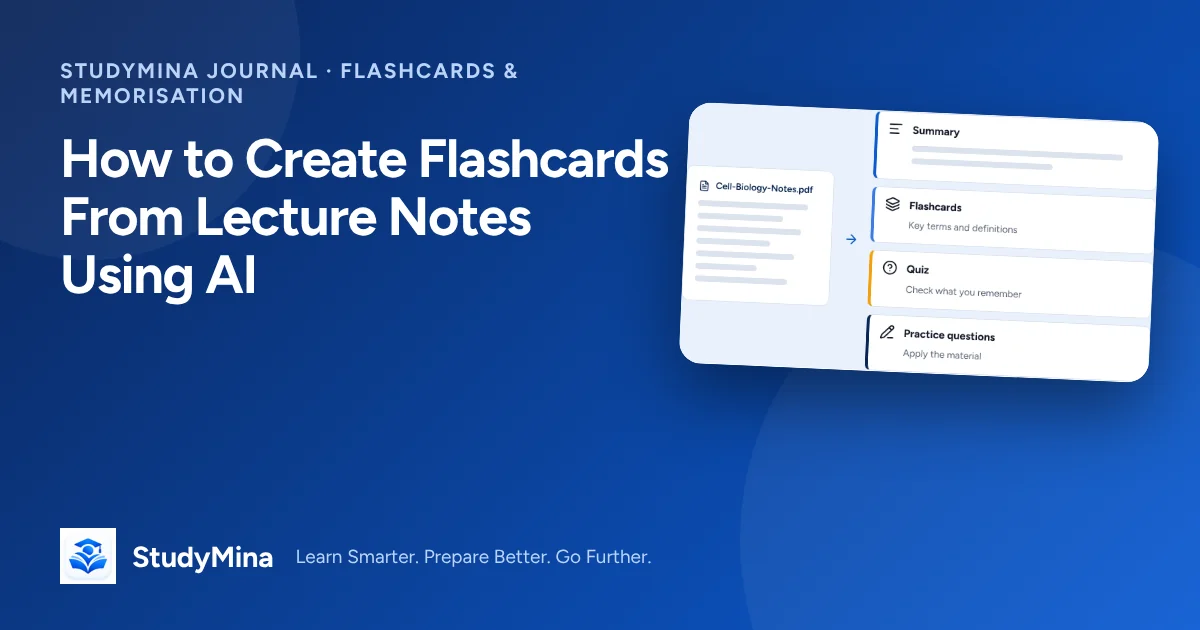
If your notes are in a PDF or slide deck, a study tool that reads documents directly can save the copying. StudyMina, for example, can create flashcards from lecture notes and PDFs.
Step 2: Ask for the right kind of cards
Generic requests produce generic cards. A better prompt is specific about card shape:
Create flashcards from the notes below.
Rules:
- One idea per card.
- Front: a clear question, not a topic word.
- Back: a short answer of one to two sentences.
- Include some "why" and "how" cards, not only definitions.
- Use only information in the notes. Do not add outside facts.
- Mark any card where the notes are unclear with [CHECK].
The instruction to use only the notes reduces the chance of invented content, and the [CHECK] marker helps you find weak spots.
Step 3: Review every card before you study it
This is the step most students skip, and it matters most. Read through the set and check each card against your notes.
Delete or fix cards that are:
- Too big. If the answer is a paragraph, split it into several cards.
- Too vague. "Explain respiration" cannot be marked right or wrong. "What are the products of aerobic respiration?" can.
- Trivial. If the answer is obvious or the question tests a minor detail, drop it.
- Wrong. Any card you cannot verify in your notes should be corrected or removed.
- Reversible by guessing. If the front gives away the answer, rewrite it.
Spending ten minutes editing a set is worth more than adding fifty more cards.
Step 4: Add the cards that AI misses
AI tends to produce definition cards. For university exams you also need:
- Application cards: "A patient presents with X. What is the most likely cause?"
- Comparison cards: "How do these two methods differ?"
- Process cards: "List the steps in order."
- Worked-problem cards in maths and physics: the question on the front, the method (not only the answer) on the back.
Write a handful of these yourself. Creating them forces you to think about what an examiner might ask.
Step 5: Study the cards properly
- Answer out loud or in writing before flipping. Thinking "I know this" is not recall.
- Sort by result. Cards you got wrong come back soon; cards you got right come back later. This is the heart of spaced repetition.
- Keep sessions short. Fifteen to twenty minutes of focused review beats an hour of drifting.
- Review little and often. A few minutes after each lecture, then regular sessions through the week.
A worked example
Imagine this line in your notes: "Mitochondria produce most of the cell's ATP through oxidative phosphorylation, which takes place on the inner membrane."
Weak AI card: Front: "Mitochondria." Back: "Produce ATP."
Better cards:
- Front: "Which organelle produces most of a cell's ATP?" Back: "The mitochondrion."
- Front: "Where in the mitochondrion does oxidative phosphorylation take place?" Back: "On the inner membrane."
- Front: "Why is the mitochondrial inner membrane folded?" (Write this one yourself and check it in your textbook.)
One sentence of notes becomes three cards at different levels of understanding.
How many cards should you make?
There is no ideal number, but fewer, better cards usually beat a huge deck. A good test: if you cannot review your deck in the time you have each day, it is too big. Start with the most important ideas from each lecture and add more later.
Common mistakes
- Trusting the output. AI can misread a diagram, merge two ideas or state something confidently that is wrong.
- Generating too much at once. Large sets hide errors and overwhelm you.
- Never revisiting old cards. Without review, the deck is just a file.
- Replacing understanding with memorisation. If a concept does not make sense, learn it first, then make cards.
The best AI flashcard maker for your notes: StudyMina
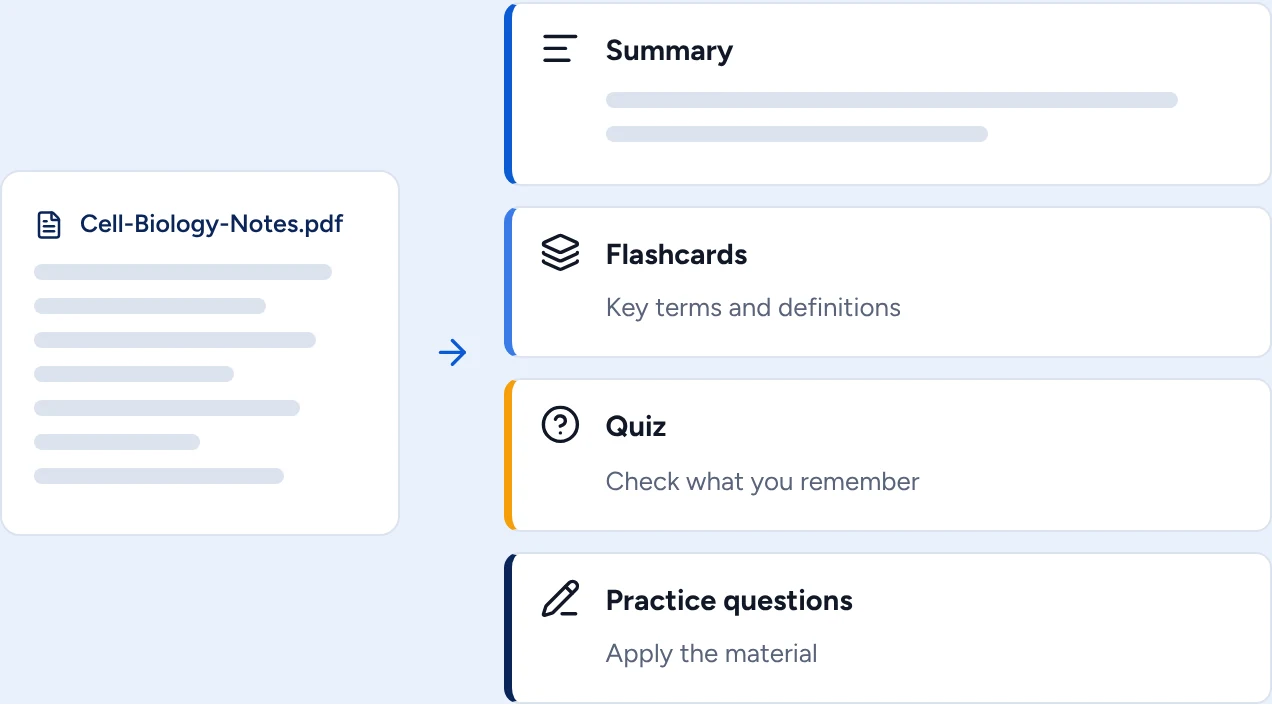
StudyMina does the first step of this method for you: upload lecture notes or a PDF and it generates flashcards of key terms and definitions from your own material, ready to review alongside quizzes and your study plan. Then apply the checks above before you start studying.
Sources
- Roediger, H. L., & Karpicke, J. D. (2006). Test-enhanced learning. Psychological Science, 17(3), 249–255. doi.org/10.1111/j.1467-9280.2006.01693.x
- Dunlosky, J., Rawson, K. A., Marsh, E. J., Nathan, M. J., & Willingham, D. T. (2013). Improving students’ learning with effective learning techniques. Psychological Science in the Public Interest, 14(1), 4–58. doi.org/10.1177/1529100612453266